
Every Picture Tells a Story
Every Picture Tells a Story - Essay Series
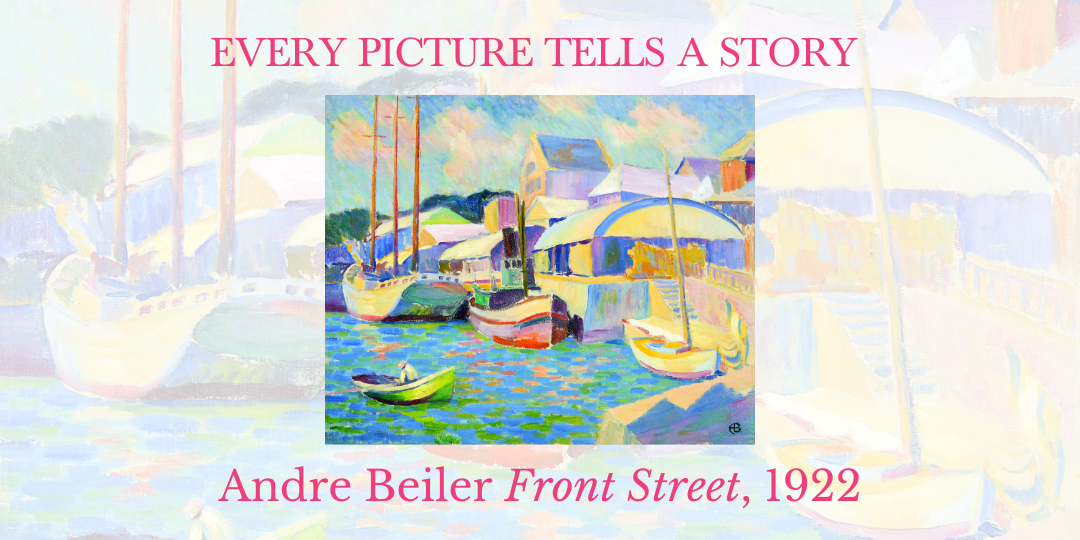
A Bermudian artist’s dream to experience the movement of recapturing landscape silhouettes in painted hews of yellow and green, where soft buttercream blues overlap, brings to life Bermuda’s ocean and sky. This visual culture is witnessed on the stretched decorated canvas to showcase Front Street 1922 splendor of fine art because every picture tells a story, even if it was one hundred years ago. I can feel the vibe connecting me to stored up images in the gallery of my mind, from a time long ago. Palette in hand, using acrylic paint and oil pastels that combine to release a three-dimensional view of numerous arrays of boats upon the circulating, glistening ocean current. This painting depicts what it might have been like in 1922, a time of tranquility only found in Bermuda’s beauty.
What a gift to live on this island of paradise filled with mother nature’s beautiful soft pastels of every color, with mixed creations of Bermuda houses in full bloom. I work together with my fingers in motion, dark to light pigment flies, the resemblance of boats take shape happily gliding and parading, moored or anchored alongside the ferry dock. This canvas captures a historical Bermuda day when wealth came by sea or land, and some lucky few fished for snappers and barracuda for their dinner plates. In this pristine atmosphere, there are no electric cables to disfigure this amazing view of a painted sky, only native birds are hidden behind billowing clouds. With only candles and oil lamps. In this era, all work is done at dawn’s light.
In the background are luscious hills that display flourishing and productive gardens with vegetables and fruits that are grown for each Bermudian home. Just beyond my painter’s eye lies the hustle and bustle of Bermudian life in this bartering economy. Dotted throughout this indigenous landscape are the scars of segregation. You will find corrugated iron tin shacks made of wood used to house the lower class. In comparison, living on this idyllic treasure of painted limestone are homes with white stepped roofs which show off prestige and wealth. It is in the complexity of this picturesque view that the semblance of our ancestral past comes to life in my mind. This genre is to draw attention to political and social links between the injustices in 1922.
I’ve found my happy medium where clouds are white and Bermudian people are a sheer delight; I’ve kept it simple. Bermudian landscape is free from the industrial revolution. Bermudian architecture with its two-story residential dwellings and the colorful Front Street shops that are a staple of Bermudian entertainment. A huge social event was to ride in a horse-drawn carriage along Front Street. It chronicles the myriad forces that buffeted Bermuda and inspired the artist to paint this picture. It is my backdrop of Bermudian wealth that came by sea for the blessed few. This picture is intended to nurture and develop an artistic view and to encourage Bermudians to experience the context of this artist’s viewpoint. Landscape painting allows the viewers to travel in their imaginations, perhaps a natural antidote to our otherwise stressful world where every picture tells a story.
– Edwina Fullerton
Andre Beiler, Front Street, 1922
On a majestic island lived two gypsies of contrasting musical rhythms; “Tom The Magnificent” & “Elise The All Encompassing”. On their magic carpet they observed something incredible waiting to be known.
Both with a keen expressive eye flying through golden clouds & rainbow colors they landed on Front Street. Having lived in darkness for over a year, the morning sun slowly appeared giving them hope of enlightenment.
They embraced two wisdom seekers with supernatural powers. Bearing gifts of artistic qualities they explained their destiny to serve humanity. Andre was a painter of pictures that change peoples lives for the better. Randolph was a wise worldly storyteller who unlocks the minds of people to use their instincts, senses & creativity to ennoble life & inspire others.
Randolph began his story while Andre painted with celebrated reassurance integrating his design methods with intense discipline. The strokes from his brush captured the curvatures of the market roof, several boats & the dark landscape in the distance. He quickly painted the architectural buildings, walls, balustrades & structures.
As the sun became like a strong bright beacon of light; Andre began adding brilliant colors like part of a natural order to his painting. He became part of his picture as he shouted, “The sun, the sun & all we can become.
He painted the shadows cast by the sun angle, the clouds above & an impressionist feeling to the water reflections from the colors used in harmony with all the elements he had painted.
The picture possessed a powerful connective secure stability & the blessings of a variety of fantastic bold colors. Andre shouted loudly that “something was missing”, in his work. It was the silence & stillness lacking movement & activity of life.
“Risa The Celestial”, evolved from beneath the harbor waters. She was selected as leader of Tom & Elise’s gypsy art village to carry the new torch of cultural knowledge.
As her gentle voice was able to restore Andre’s spiritual guidance with repose & poetry all its own; Andre noticed a small boat entering the the port with a tired man, shoulders bending over his body to rest. Andre quickly added this figure as a monumental moment to his painting.
We were all in awe how the picture came to life. Understanding how the small things in life give a sense of love, deep hope, joy & happiness in our lives is so important. Artistic expression too, are gifts from our “Maker”, like the land, sky & sun. Andre’s painting was nature’s instrument with the principles of life & form.
The emotional impact & value of this painting is now complete. All together, hand in hand, we bountifully said; It is a masterpiece.
– Randolph Marshall
FRONT STREET, 1922 - Andre Belier
Bygone days, twixt two terrible World Wars, a time of healing from the First, only four years past. Art, too, had suffered, and healed from Cubism, Futurism, and Dadaism, presaging Surrealism. The ‘isms’ of experimentation, overlaying the horrors of the orchestrated failure of nations. Art echoing life. Andre, injured in WW1, exuded Modernism.
Out into the bright light of a somnambulant Bermuda of the 1920s, out into colourist trials and fleeting shapes, reversing quayside drab, sparkling with gusts of raw colour. His flirting with the eye’s perception, yet not distorting perspective too much. Clearly, one funnel, four masts pointing skyward, four hulls, three sheds, and the many planes of roofs – interesting negative shapes, contrasting with a ‘sketchy’ sky, with its cotton wool clouds.
Bermuda, an ocean speck, a waypoint for voyagers, a staging point for navies, at the crossroads of West-East and South-North. In essence a ‘shed’ for outsiders, but a haven for boat-born artists. A paradise for ‘belongers’ with simple tastes, appreciating more gentle times, not given to hasty acceptance of nouveau, perhaps even shunning new ways, new art.
‘Front Street’s tapestry of colour, energetically applied in haste – untypical of that languid time. ‘Flattening the Plane’ was in vogue, jigsaw shapes, bold edges, and elimination of aerial perspective – another blip on the road of ‘isms’. His block-like solidity, akin to stage sets in effect, have an equilibrium of form, with none outranking the other.
Interesting for such a busy scene, is the absence of animate form, save for the lone oarsman in his harbour workboat. Did the artist seek to conjure the loneliness of artistic endeavour, the futility of activity in an increasingly mechanized world, or, simplifying yet further, a reduction to the core values of light and amplified hue?
We shall never know his reasoning – as with most art, the caveman’s motives, choices, distractions, and limitations are all eradicated by time, with just one element remaining – the painting itself. Postulate we might, it is all conjecture, a haze over the work that matters little. The viewers, each in turn throughout the ages, each entering an unspoken dialogue across time. The finished work silently speaking to an unfinished life, harmonizing with experiences and visions.
And so Andre’s work, juxtaposed with similarly aged art, forms part of the gallery’s tapestry, another weft in the warp of time. How long do you stay, do you linger, give it your real ‘attention’? Sweeping your gaze, back and forth across its colour fields – how long? Dally a while, here and there in colour corners, marvel at the water treatment, rest in its untutored boldness, its rejection of detail, its gutsy cheekiness.
What would Belier say of all these attempts at wrapping words around images? Perhaps quietly just bring out another canvas, from another time, to show another facet of life that you have not lived. And, as with the caveman, just let you see the cave wall ‘marks’, left by a hand that is no more – Tempus Tempura Fugit.
– Grahame Rendell
FRONT STREET - On the Waterfront
He shifted his oars for the very last time today having taken passengers to and fro Hamilton to Paget or Warwick. Even his oarlocks felt the fatigue. It had been a busy day and by his standards a lucrative one. Slumped now as he was he paused to reflect about life at home, his wife of 30 years and their five children, three of whom were able to help their mother around the house the younger two needing care. Today he had seen the departure of the Furness-Withy liner Bermudian leave for New York and the arrival of a schooner from the Caribbean with its charge of rum.
Bermuda’s reciprocal trade at the time was with the east coast – onions, lilies, tomatoes, in exchange for lumber, building supplies, foodstuffs. Rum from the Windies was a one-way flow! Now at this time in a world more genteel goods that arrived in Hamilton’s Harbour were placed in open sheds – a roof, no doors, no locks, no keys, no security guards just a cover to keep the rain away. The sheds numbered one through seven and it was here that the horses with their carriages would take the goods to both ends of the island; so too the working boats that sailed from the harbour to Somerset or St George’s. These boats were intentionally over canvassed as it was a race and time was of the essence. These skilled sailors Took many risks for their boat owners. It Can only be imagined that steam was still slow by comparison …
Now the boats were not the only things that so vividly brightened the harbour, so too were the buildings and warehouses along Front Street. Pastel Buildings of yellow, sienna, burnt umber, roofs of white with the occasional slated rooftop. Calm waters these colours would get mixed in the reflection and create a rainbow on the water. In part, it was this that inspired our oarsman who would wax eloquently to visitors from the east coast. Some came to paint, some to write, photograph, or simply escape the smog, the filthy air, and winter’s harsh realities. Far away from the hustle and bustle, the noise of factories, cars, and buses lay the semi-tropical paradise using only the natural environment for transportation be it wind, beast(horsepower), or what was found in the strength of a person’s arm. Stories to tell silently slipping through this enchanted harbour. The day’s end … Tomorrow would be the same, new faces perhaps but the same stories to be told to a captive audience … the endless to and fro.
– Tom Butterfield
STEPS ON FRONT STREET
“Mummy!” I shrieked, “I see fishes.” My first words when the flying boat splashed down on the Great Sound in Bermuda. As we taxied towards Darrell’s Island, the water continued to ripple past the window. I could hardly contain myself as I jumped up and down with excitement. I could not have imagined that the thrill of seeing water and fish would become part of my life. I knew I was going to attend kindergarten but never dreamt I would be going back and forth to school by boat.
Mr. Walter Ingham and Vesta, were my horse and carriage. Four days a week his sturdy row boat took Mummy and me the third of a mile from Lower Ferry, Paget to Front Street. This was the only ferry service between these two landings in the early ‘40s. There were days when it was rough, and at times everyone in the boat would be sprayed with water from the tips of the oars. No one seemed to care, though it did cross my mind that neither Mummy nor I could swim. But before long we were at the Front Street steps.
It was on those steps that I would stand and watch the waves curling and small fish darting in and out. The fish seemed to believe they were safer there than in the deep. Then a swell would come and sweep them helplessly out into the depths. I was transfixed by this activity. It all seemed choreographed by Neptune.
The steps were blanketed with green algae, a source of nourishment for the fish, but soft and slippery to stand on. Limpets clung to the wall and stairs as did sea urchins; I thought of them as ocean hedgehogs. I could have stood on those steps all day watching the fish flash by twisting and turning, or treading water with their tiny fins becoming a blur. I often stooped down believing I could scoop them up in my hands, but they would vanish.
As the weeks went by Mr. Ingham began to point out some of the small fish. There were Molly Millers, bream, four eyes, and, “Oh, Miss Jane, the black and yellow striped are sergeant majors, the silver ones with a yellow stripe are grunts and the smallest ones are fry”. Then a red one would streak by and he would tell me that was a squirrel fish. Or an even more colourful one could be seen nibbling algae from the wall, and that I was told was a parrot fish.
Mr. Ingham would continually call out “Oh, Miss Jane”. He was eager to share his knowledge, and I was eager to learn.
Each day after kindergarten, my Mummy would meet me and we’d walk back to Front Street to catch the boat to take us home. I would often run ahead urging her to walk faster as I could see Mr. Ingham and Vesta getting closer, and that would mean a shorter time in the water. Running for the boat I would try and take off my shoes and socks, hearing Mummy’s voice pleading with me to, “slow down and wait at the steps”, but it all fell on deaf ears. Once at the steps I would sit on the top one and stare into the depths. As Mr. Ingham approached, I would hold on to the wall, and walking carefully down, let the water ebb and flow through my toes hoping that some little fish would do the same. Small crabs scattered and only too soon the boat would arrive. Mummy seeing my reluctance would remind me that others were in the boat. Mr. Ingham would also encourage me to get in quickly, assuring me the fish would still be there tomorrow.
The first thing I would do upon getting into the boat was to pay the sixpence fare. I would search in my pocket and finding the sixpence would put it into Mr. Ingham’s large and calloused hand. Sometimes he was late picking us up because of choppy water. There were other days when I fervently hoped he would not come. On the days when it was rough, he was silent, as the waves pushed the boat around and he had to pull hard on the oars to ease closer while not crashing against the wall. He was focused on getting everyone up and down the algae coated steps safely. He had no time to talk about fish. Once everyone was settled in the boat, he would use his oar to push the boat away and would turn to me and say, “Not today, Miss Jane, not today”.
It was Andre Bieler’s, Front Street, 1922 that stirred memories of the innocence of childhood and the joy of discovering the ocean and the unexplained world it concealed.
KJM
August 2021